Service · 2026
GeoForge
Own the ads in your ZIP code.
- Role
- Service design, software and operations
- Status
- Live — taking clients
- Built with
- Cloudflare Workers · Stripe · Client portal · Automated reporting
- Live
- geoforgezip.com ↗
The offer
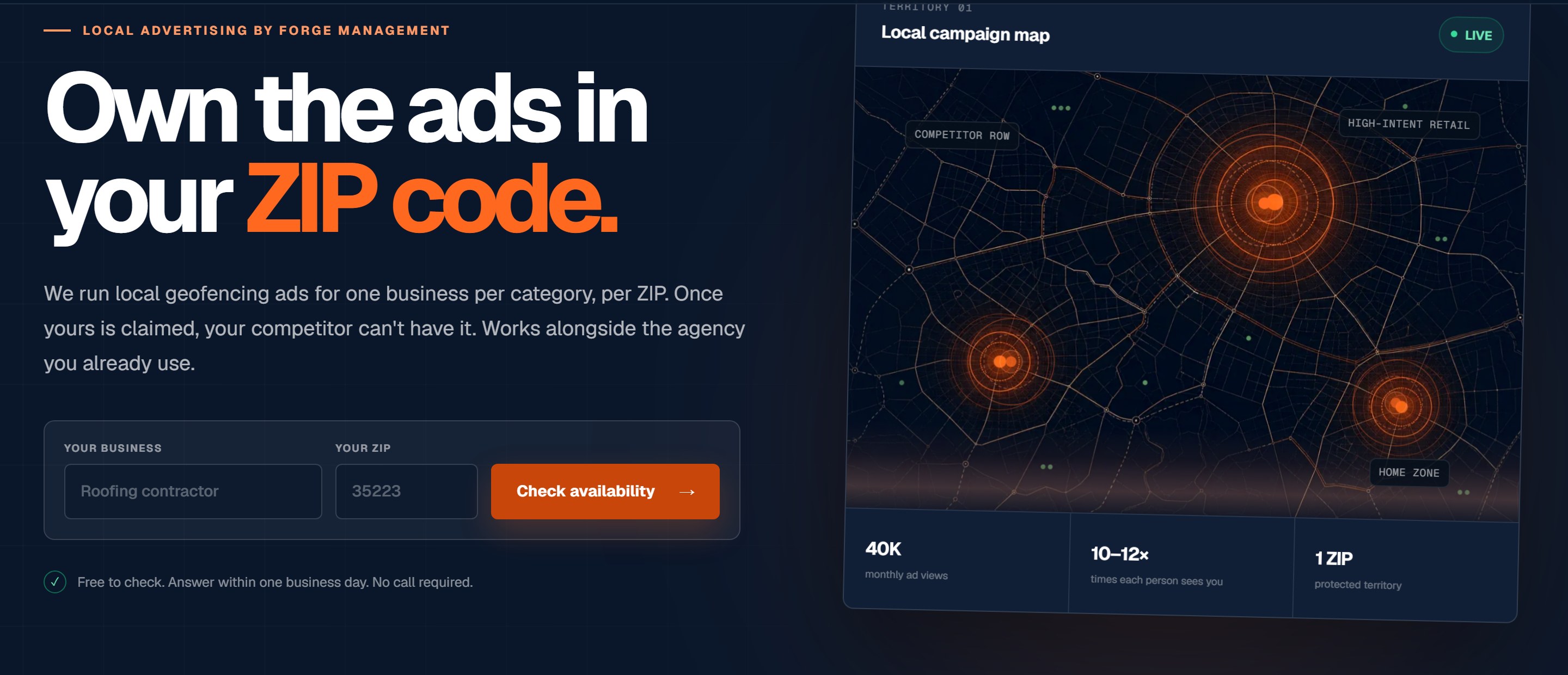
Most local advertising is sold by budget, which means a contractor’s only lever is to spend more than the contractor down the road. GeoForge sells territory instead. You claim your category in a ZIP code, and while your plan is active nobody in your category can claim it. That exclusivity is in the agreement, not a promise made on a call.
It runs alongside whatever agency a business already uses. It is not a replacement for their Google or Meta accounts, and it does not touch them.
Two ways to target a place
Geotargeting covers an area — a ZIP, a neighbourhood, a town — and reaches the people who live, work and spend time in it. That is the awareness layer.
Geofencing draws a boundary around one building: a competitor’s lot, a supply house, a stadium. It reaches the devices that actually go there. That is the intent layer, and it is where the good leads are.
Every campaign uses both. The ZIP is the base, the fences go on top.
The first ninety days
Nothing is bought until the client approves it, and the sequence is fixed so they always know what week they are in.
Week one, the ZIPs and the specific buildings worth fencing are mapped, and the map goes out for approval. Week two, ad concepts for that market are produced and approved. Week three, it goes live and the category locks.
Then reports at thirty, sixty and ninety days covering what ran, where, and how many people saw it. Real delivery numbers. Not a modelled return on investment that nobody can check.
What I actually built
The service is the product, but it runs on software: a site that checks ZIP availability and takes checkout, a client portal, campaign and creative tooling, and the reporting that turns delivery data into something a roofer can read without a glossary.
What it will not claim
Views and reach are planning estimates and the site says so on the page they appear on. Campaigns run on enterprise location inventory, not on Google or Meta. And a ninety-day launch period is the real commitment — after that it is month to month with thirty days’ notice, because a service that has to trap people is a service that is not working.